The Lighthouse

the lighthouse

14 September 2013

Bits and pieces.

The forgotten verses
Do you ever wonder about the verses that get left out of the readings? I do, and will sometimes look them up and read them anyway, just so they will feel included. I wonder about why they got left out. Was it that poor old David got it right for verses 1-3, 5-9, 11-17 but missed the boat with four and ten?
Sometimes you find a gem in the forgotten verses, like this one from yesterday:
Because you will not abandon my soul to the nether world, nor will  you suffer your faithful one to undergo corruption. (Psalm 16;10)
I've been praying a lot lately for the grace to want to want God, and reflecting on whether my priorities are right. Am I living a life pleasing to God? How will I be judged at the end of it? I was worrying about being lukewarm, apathetic, and destined for unpleasantness. And not out of scrupulosity... it was a fair assessment of where I was at. Suffice it to say that forgotten verse 10 has given me substance to ponder and a dose of reassurance.

Yom Kippur
Yesterday ended the great Jewish feast of Yom Kippur, the Day of Atonement. It is a day of forgiveness, of being made right with God, and has to do with vows which bind us and keep us from Him. One of the most moving pieces of music, religious or worldly, is the Kol Nidrei. Turns out this is actually a legal document... and never has the law sounded so beautiful.


*If you are unable to play the video but would like to, this came from Youtube and is titled:
Kol Nidrey, Moscow Male Jewish Capella, Cantor J Malovany.

Heatwave to windchill
Our weather this week: Hot. Heatwave. Heatwave. Heatwave. Windchill. Nice. We went from it being 32 degrees, feeling like 42 with humidex, to being 14 and feeling like 11 with windchill. Today should be perfect, with it being 17, and feeling like 17.  Leave it to numbers to mess even with the weather.

Hamster balls. Introverts, personal space, and the lady who may as well have sat in my lap.
Some time ago I wrote about being an introvert and how a friend had shared that being an introvert was like being in a hamster ball. Introverts need personal space - physical, mental, emotional room. You know you're in the presence of an introvert when you lean over the desk toward her and she pulls back. Maybe even takes a step away. An introvert will 'accidentally' click out of a chat room when someone barrages her with personal questions, like a nosey, intrusive fusillade.
(Have you noticed how much is being written about introverts and introversion lately? Every week there is a new something or other on Facebook about 'introverts aren't gonna take it anymore'. I think the reason is that the built-in buffer of the internet has provided us a safe environment to reveal ourselves, speak for ourselves, whereas the in-person nature of yore kept us more tightly tucked in to ourselves.)
Last Sunday at Mass, I sat in my pew. This was at a fairly large church. There are two rows of pews off the central aisle, and each row is divided by a small 'arm rest' half way along - a helpful demarcation of 'my space' and ''your space'.
You know where I'm going with this, don't you?
With three empty pews around me in every direction, a lady chose to sit in my row.  But not just in my row. She sat right beside me. In fact, I had to pull my purse out from under her.
I moved.

Call the midwife, Christmas special.
Are you at loose ends while ever so patiently awaiting the next series of Downton Abbey? (Not, as some of our library patrons call it, Downtown Abbey. That would be a story of a different sort, yo.)
If you are, it's time to Call the midwife. This is a lovely series based on a real life story of nuns and nurses who serve some of London's poorest women as midwives. It takes place in the 1950s, and while that period isn't all that far behind us, the story feels like looking in on history.
I just watched the Christmas Special, included in the series two set. Charity, love, kindness, compassion, service... all acted out in entertainment. It was moving, beautiful, inspiring, edifying.
There is a scene between Sister Julienne and an old lady outside the clinic that jolts you wide awake, because you recognize you are seeing the Gospel portrayed right there on the screen.

You see, Hollywood? It is possible to entertain, to appeal to the masses, and still tell a good story. You can build people  up rather than numb them with banality or corrode them with slime!

I hope the sun is shining where you are, dear Reader.  I'm off hunting for inspiration at a local art and craft show.
A blessing on your head, mazel tov, mazel tov.


09 September 2013

Five sentence fiction: beauty


Photo Credit
I tried to be cool. The marvels of Pisa, the history of Siena, the glamour of Florence had all inspired and impressed me. It happened here, in this meadow not found on any map nor listed in any guide book, that it happened to me: I became a cliché. I could feel the moment overtaking me, yet was helpless to prevent it - it was inevitable. With arms out-flung, head thrown back, I let loose the full-throated cry: Beauty!


Five Sentence Fiction, hosted by Lillie McFerrin Writes

03 September 2013

In defense of food

Did you know that food needs a defender?

It does.

And we need our food to be defended.

I've read many books about food lately, from Anthony Bourdain's food travelogues, to books about untrained foodies learning to cook, to manifestos of slow food, local food, and bee keeping.

After reading so much about what we're eating and how - mostly in praise of food in one way or another - I was very surprised by how startling, appalling, and even enraging, Michael Pollan's In defense of food turned out to be.  I've watched Food Inc. more than once... I didn't think I could be more appalled or enraged when it comes to modern western food.  Well, Mr. Pollan refers to western food, western food culture, and western diet, but I wonder if he really means North American. Surely much of Europe keeps to its traditional food culture? I'll forgive him that rather American myopia, and accept that 'western' food is in dire need.

It is in need of being left alone by food scientists, nutritionists, lobbyists, and massive companies. It is in need of changes to industrial farming practices, monocultures, artificial intervention of fertilizers and pesticides. It is need of returning to being actual food.

To me, this book is common sense expounded over the course of some 200 pages: eat real food; eat food your grandmother would recognize; food, what we get from it and what we need from it, is much more complex than we fully understand, much as we tend to believe in the supremacy of science and believe in our grasp of that science.

Messing with food by extracting bits and then adding other bits is causing all kinds of problems we don't even realize are problems stemming from our interventions.

When I first started reading about the 100 mile diet, I sank into a funk. I live in Canada. Think of all you know about Canada, and then ask yourself: what would Canadians eat if tomorrow all international transport ground to a halt? We have such a short growing season with long stretches of frozen earth. People used to eat only what they could grow themselves, or trade with neighbours. (Thinking back on my only attempt at potatoes so far, I wonder if I could have traded short stories for spuds back in the day?) It didn't seem fair to me that we wouldn't have access to pomegranates or avocados or many other 'super foods' we're supposedly supposed to eat for optimum health.

'In defense of food' reminded me that food cultures all around the world are limited because no one area grows - or raises - everything edible. Each region, faithful to their food culture and traditions, thrives, whether they seem to use pounds of butter in their cooking, or consume only blood and milk, or eat mostly blubber. Each region, over the many centuries, has figured out how to best combine and prepare foods local to them, such as adding olive oil to tomatoes, or eating beans with corn and rice. We have gone wrong by over processing our food and over complicating our relationship with food. We now have to eat more of a thing in order to get the same nutrition from it compared to our grandparents' generation. We spend less money for, and less time preparing, our food than Italy, Spain, and France (I'd argue we also enjoy it far less, and have less healthy attitudes toward eating than they do.) but consume more and suffer more food-related health issues. We spend more time thinking about food - snacks, advertisements, shopping, calorie counting, diet-obsessing - but less time actually eating meals than other countries.

Oops. Got sidetracked there. I was going to say, way back at the top of the last paragraph, that the book reminded me that though we rely so much on our knowledge of science to be the answer to all things*, God is a master craftsman, and no detail has been overlooked. If the human body needed the Mediterranean diet for optimum health, we'd all be blessed with the Mediterranean climate and soil. God designed the body to work the way it works. He knows about the omega fats and antioxidants and the vitamin spectrum and how it all works together for our good. He provides it all... it just looks different, comes to us in different ways, from one place to another. And His way of providing nourishment for us doesn't upset the balance of delicate things we do not yet understand, the way that lobbyists, mega corporations, nutritionists, and food scientists have done.

Faith and reason, boys and girls, they do go hand in hand. In other words, do not let blind faith in science blind you to the understanding found in faith.

Eat real food.


*the answer to life, the universe, and everything just might be 42.

02 September 2013

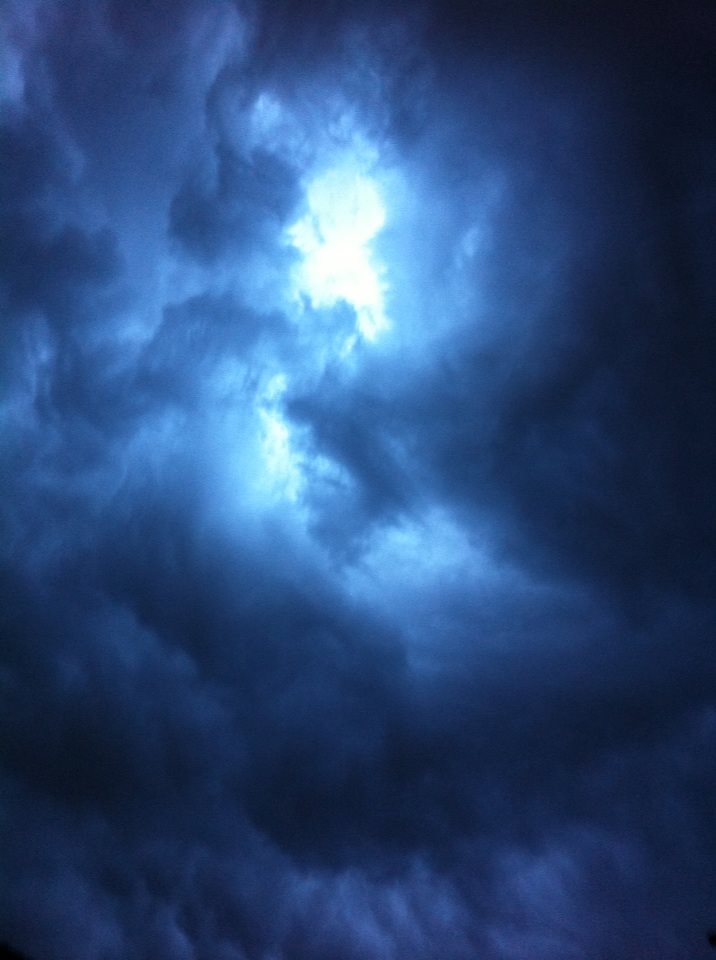
Five sentence fiction: Thunder


Photo credit: Tess's Own
Dark.
Black as pitch.
Flash of white tears the sky in jagged two.
Vicious claps attack in waves.
Thunder.


FSF is hosted at Lillie McFerrin Writes; I came by way of  K R Smith.

31 August 2013

The Great Reading project: Gift from the sea

What a gem this book is - a gift indeed.

Anne Morrow Lindbergh, in 1955, took a vacation on the Florida Gulf Coast, during which she wrote this collection of reflections inspired by various found treasures on the beach. And treasures on the beach, as we all know, are shells.  Each shell - the Channelled Whelk, the Moon Shell, the Double-Sunrise, the oyster bed, Argonauta -  provides her food for thought about the interior life, relationships, and daily life.

Gift from the sea, though a slender volume and written in a thoroughly approachable fashion, imparts wisdom, inspiration, and, insight enough for months of meditation and reflection. Though men as well as women would glean much from this book, the author writes very personally from her own experience and knowledge as a woman. She touches particularly on a woman's need for quiet, creativity, purposeful giving of herself, and knowledge of herself in order to know and connect with others in meaningful ways. I heard echoes of Alice von Hildebrand and Edith Stein in some of what she writes, and in fact she quotes from several Catholic saints.

If I could copy out the whole of the chapter titled 'Moon Shell' for you to read here, I would do so. In it, Anne writes particularly about the importance of feeding the soul, and feeding the soul requires silence and solitude in some measure every day, every month, every year.
Amen!

My one complaint of the book isn't really a complaint so much as a moment of sadness and came while reading the epilogue of the 50th anniversary edition I have. The epilogue was written in 1975 and the influence of the feminist movement is evident. In this little book is evidence that one of the results of radical feminism is stripping beauty out of the feminine, leaving ugliness in its place. I hasten to reassure you that Anne does not spout feminist diatribes, but it is clear that the movement in full swing by 1975 has coloured her writing.

And so concludes another book from The Great Reading Project. I have begun on Dante's Inferno, the book that sparked this initiative. It's the one I've really really been wanting to read, so here goes!


Small Island  - Andrea Levy

Inferno – Dante

Heart of the matter – Graham Greene

The Snakepit – Sigrid Undset

Sound and the fury – William Faulkner

Man and woman – Alice Von Hildebrand

The Cloistered Heart – Nancy Shuman

Invisible man – Ralph Ellison

Masterful Monk (series) – Owen Francis Dudley

Shepherd’s castle – George MacDonald

Last light – Terri Blackstock

84 Charing Cross Road – Helene Hanff

Gift from the sea – Anne Morrow Lindbergh

Unlocked – Karen Kingsbury


25 August 2013

Five sentence fiction: travel


Five sentence fiction: travel

I felt trapped in the mass of bodies on the train; limbs hung out of windows and pressed against the doors. The landscape rolled passed in dry and dusty counterpoint to the vibrant clothing of my fellow passengers - a riot of colours lending exuberance to this unfamiliar place. They spoke excitedly - and loudly - to one another in languages I could not comprehend, sharing food I could not name but which tantalized my senses. How different India was from my adventures last night in comfortingly familiar England!
With happy anticipation of what tomorrow would bring, I closed the book and turned out the light.

Books can take you anywhere